🚨 France Visa Slots Filling Fast – Secure Your Appointment Today!
🚨 France Visa Slots Filling Fast – Secure Your Appointment Today!
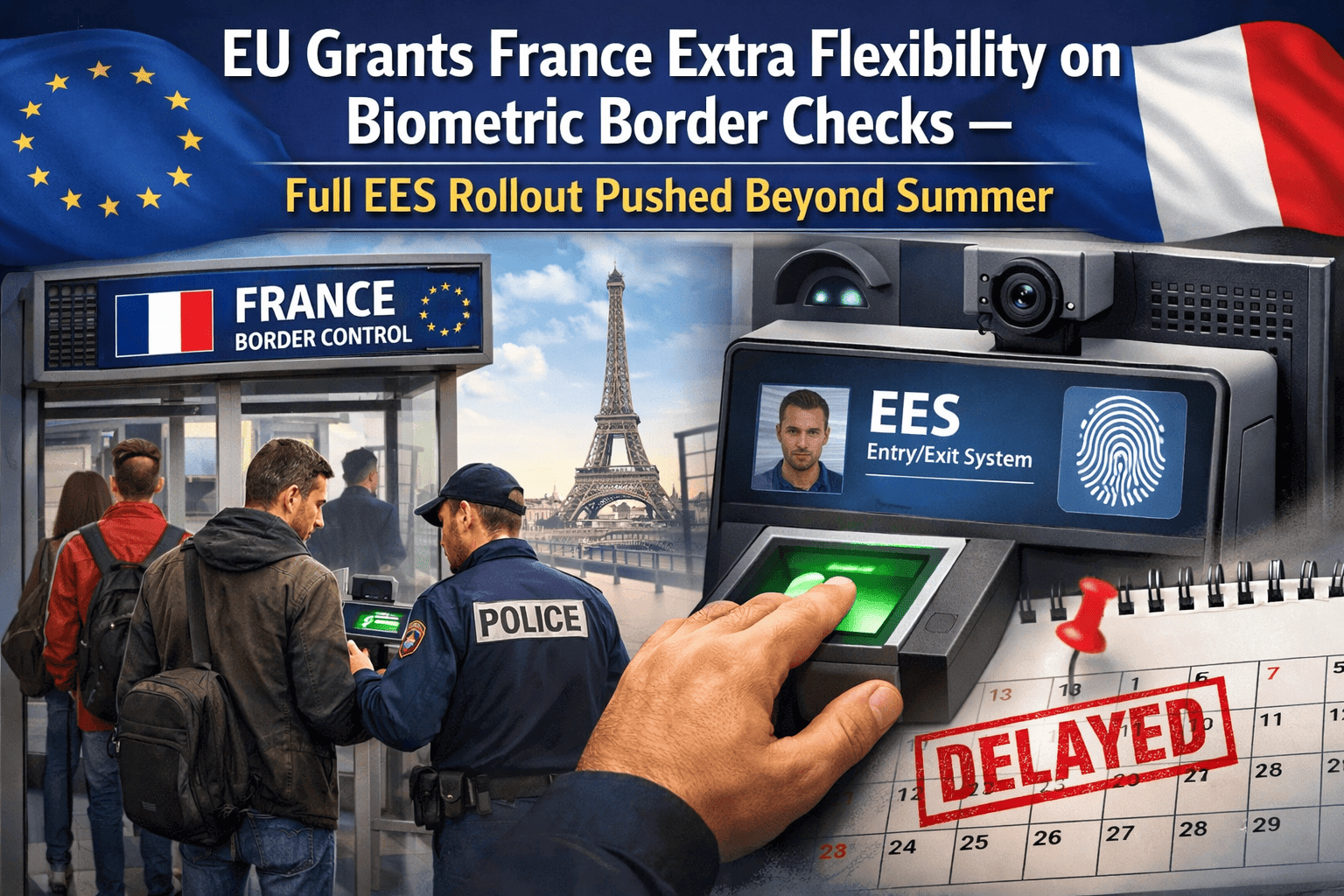
EU Grants France Extra Flexibility on Biometric Border Checks — Full EES Rollout Pushed Beyond Summer
It is reported that the European Union has agreed to allow France an additional flexibility when it implements biometric border controls and allows France to delay the complete rollout for the Entry/Exit System (EES) until after the peak summer travel season. The decision comes amid the growing concern about security, congestion as well as the practical consequences of introducing massive biometric checks at important European border crossings.
Instead of imposing a strict timeframe for implementation, EU authorities have opted to take a more practical approach, allowing France the flexibility to oversee the border without affecting high-volume travel.
The Entry/Exit System is a new digital border control framework designed to modernise how non-EU travellers are processed when entering and leaving the Schengen Area. Once fully active, EES will electronically record:
The system is intended to improve border security, reduce fraud, and provide more accurate tracking of short-stay visitors, including those travelling on a France visa.
The EES is a central element of the EU’s effort to modernize border control. It is designed to replace passport stamps by digital records of entries and exits, this system records biometric information which includes fingerprints and facial pictures that are taken by travelers who are neither EU citizens nor residents. This approach to digitalization aims to increase security and help identify infractions of overstay, and enhance the accuracy of border inspections.
However, the process is not without obstacles. The major French airports as well as cross-Channel terminals have faced long lines as well as logistical bottlenecks since the biometric systems and kiosks are put in place and tested on a larger the scale. These problems prompted Brussels to rethink the timing of the deployment to ensure that there isn’t a major disruption during peak travel times.
With the latest approach that was endorsed by the European Commission, member states including France could temporarily stop or decrease the frequency of biometric verification in times of high traffic. As long as the system is not operational, border officers can return to stamping passports manually at specific crossing points to reduce congestion and ensure more efficient travel flow.
The reality for travelers will be this: the coming summer could bring the introduction of a hybrid system of biometric and manual inspections at French border crossings, instead of an uniform biometric procedure. This flexibility is helpful in avoiding lengthy wait times, it implies that travelers can anticipate occasionally a change in how the border control procedures are carried out.
For anyone planning travel to France — including UK nationals requiring a France visa — this phased approach to biometric checks doesn’t change the core entry requirements. Visa applicants must still ensure they meet all documentation standards, including valid travel documents and any necessary consular approvals, before arriving at a Schengen border.
However, the transition period underscores the importance of good travel planning:
In its initial phased way from the end of 2025 The EES was designed to protect the Schengen Area’s border with outside countries by electronically registering all arrivals from outside the EU. The system was expected to be fully operational by the end of April 2026. However, operational limitations have led to the adoption of a more cautious strategy.
In the framework of the EU’s phased approach the member states are constructing their capacities to manage biometric data collection but still stamping passports in the manual manner when required. The system is expected to remain in operation through the summer months, but an expanded biometric rollout scheduled for Sept. 2026 or sooner, if authorities work out the infrastructure and staffing arrangements.
Alongside EES in addition, the EU is preparing to launch an ETIAS, the European Travel Information Authorisation System (ETIAS) by the end of 2026 or 2027. The electronic travel authorisation is applicable to travelers who are visa-free and require an online application prior to departure. Although ETIAS isn’t yet in effect however, preparation for the future — and knowing the way EES as well as ETIAS will interact is crucial for any future trips to France as well as other Schengen countries.

For travellers from the UK preparing to visit France, navigating the Schengen visa process can seem complex — especially amidst evolving border systems like EES and future travel authorisation requirements. That’s where Francevisa.org.uk steps in.
Our platform offers clear, up-to-date guidance on the France visa process, including documentation checklists, appointment support, and expert tips to help you submit a solid application the first time. Whether you’re heading for leisure, business, or study, FRANCE VISA FROM UK simplifies your journey by providing:
With specialist assistance at every stage, you’ll feel confident and prepared — even as European border processes evolve. Let us help you secure your France visa with ease and certainty.
When the summer travel season is over, France is expected to shift to full biometric compliance under EES which will bring borders procedures into accordance with the EU’s long-term security plan. This will also set the scene for future systems like ETIAS, which will further strengthen screening prior to travel for visa-free travelers.
For travelers to Europe, the message is simple The borders of Europe are constantly changing and are not closing. Anyone who is prepared properly – -particularly visa applicantswill be able to gain from more clear rules as well as more consistent screening and less apprehensions on the way to the frontier.
This decision by the EU to give France more flexibility is not an extension of the security protocols, it is rather a strategic change. Prioritizing operational readiness over strict timelines, the authorities seek to safeguard both the integrity of borders and the experience of travelers.
For those who plan to visit France during the next few months being informed and preparing the best visa application is the best way to travel in confidence.



 447300463745
 02084326004