🚨 France Visa Slots Filling Fast – Secure Your Appointment Today!
🚨 France Visa Slots Filling Fast – Secure Your Appointment Today!
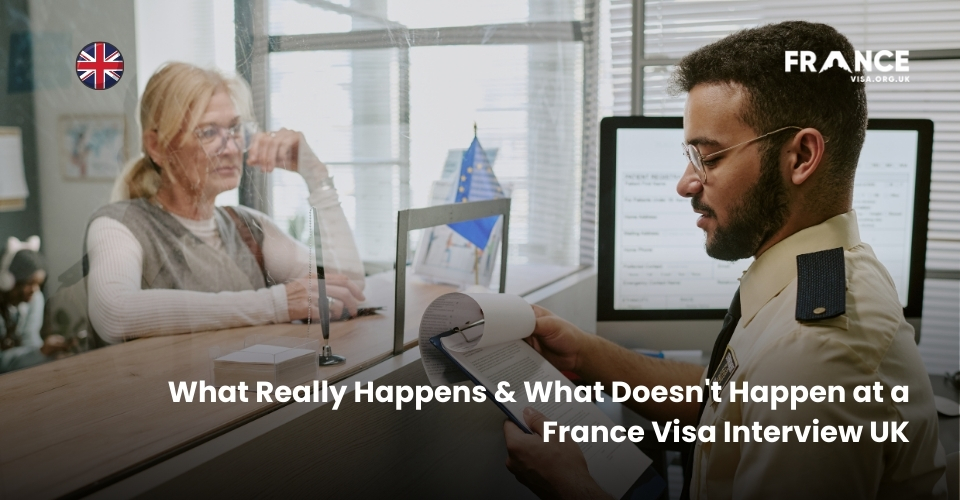
The word “interview” can be scary for many people in the UK who are applying for a France Schengen visa interview UK. People often envision a rigorous in-person test, challenging questions, or potential judgement based on their accent, confidence, or previous travel experiences. Online forums don’t help either; they are full of stories that make the Visa for France from the UK process seem a lot more stressful than it really is.
The reality for UK applicants is completely unique. In most cases, there is no formal interview at all. You attend a document submission appointment, usually at a visa application centre in cities like London, Manchester, Birmingham, or Edinburgh. The focus of visa officers is not on questioning you; moreover, it is on checking paperwork, taking biometrics, and ensuring your application is complete and consistent.
This guide explains what really happens, what does not happen, and how UK applicants can approach the France visa process calmly and confidently in 2026.
Let’s first address the most common misconception. For the majority of UK applicants applying for a visa for France from UK, there is no traditional interview. Instead, there is a structured appointment where your documents are reviewed and biometric data is collected.
Note: Statistics from Schengen visa trends indicate that the UK decides over two-thirds of applications without extended questioning. Instead, the questions posed are concise, factual, and closely connected to your documents.
The visa application centre regularly organises the process when you arrive. Following the security checks, you receive a token number and patiently await your call. Once at the counter, the staff member will check your documents one by one, confirm details, and collect fingerprints and a photograph if required.
At this stage, you may be asked a few simple verification questions for a France visa appointment UK, such as:
These are not interview questions in the traditional sense. They exist only to confirm that what you say matches what you submitted on paper. Most UK applicants report that this part takes less than five minutes.
Fact: Applicants with complete documents often leave without feeling like they were questioned at all.
For UK applicants, visa decisions are based on risk assessment, not personal impressions. Officers evaluate your application using clear criteria for France visa interview questions.
It’s fine to go for tourism, to see friends or family, for business meetings, or to take short courses. What matters is that your goal is clear, realistic, and backed up by things like hotel reservations or letters of invitation.
You don’t need a lot of money, but you should have a steady income or savings that reflect your finances.
Note: Around 35–40% of Schengen visa refusals from UK relate to unclear or weak financial documentation rather than interview performance.
This feature is especially important for non-British residents in the UK. Employment contracts, business registrations, tenancy agreements, family connections, or long-term residence status all help show that you intend to return to the UK.
Many fears about the France Schengen visa interview UK are simply myths some are as follows.
Note: UK applicants often worry unnecessarily because the process feels unfamiliar. In reality, it is administrative, not confrontational.
Understanding real refusal reasons removes anxiety. Let us discuss the real reasons for the France visa refusal and the percentage it holds in rejections; some are as follows:
| Reason for Refusal | Approximate percentage hold |
| Missing or unclear documents | 40% |
| Unclear travel purpose | 20% |
| Insufficient financial proof | 15% |
| Weak UK ties | 15% |
| Other reasons | 10% |
Note: it is important for UK applicants, as most refusals are linked to missing or unclear paperwork, not what was said at the appointment. Most are linked to what was missing or unclear on paper.
If someone asks you a question about your France visa appointment UK, the best strategy is to respond simply and directly, without overanalysing it.
For example:
Note: There is no need to add extra details or long explanations. Officers prefer clear, consistent responses.
Well-prepared UK applicants usually face minimal interaction.Some of the documents during the France visa interview questions are:
Strong documents include:
Fact: UK applicants with previous Schengen travel history have around a 15–20% higher approval rate than first-time applicants.
One of the biggest issues seen in UK applications is inconsistency — dates not matching, different hotel names, or mismatched travel plans across documents.
Another overlooked point is presentation. You do not need formal clothing, but clean attire helps create a calm first impression.
Note: Arrive early, carry documents in order, and avoid last-minute changes. Rushed applications are more likely to contain errors.
After submission, your role is complete. Applications from the UK are typically processed within 7–15 working days, though this can increase during summer, Christmas, and school holidays for a visa for France from UK.
You will only be contacted if additional documents are required. Silence usually indicates that your application is progressing as expected.
Let’s dive in to explore the various visa interview questions that are commonly asked and determine whether this is truly a reality, as shown in the table below:
| Expectation | Reality |
| Formal interview | Document submission |
| Tough questioning | Basic verification |
| Judged personally | Assessed on paperwork |
| High Stress | Routine process |
For UK applicants, the France visa interview UK is mostly a myth. What actually happens is a document-focused, procedural appointment designed to verify information — not judge people.
If your documents are clear, your finances make sense, and your UK ties are strong, your France Schengen visa interview UK will be smooth. Most stress comes from misinformation, not the process itself.
France remains one of the most accessible Schengen destinations for UK-based travellers, and with the right preparation, the experience is much simpler than many expected.
No. Most UK applicants attend a document submission appointment. Any questions asked are short and linked to paperwork.
Yes, but these kinds of things don’t happen very often. Your answers during the visa interview are crucial. If they are unclear or make it seem like you want to stay longer, you could be denied.
It is structured, not strict. Genuine applicants with clear documents usually find the process smooth.
Sometimes, first-time UK applicants face questions, but these are basic and factual rather than challenging or personal.
Yes. All applicants must visit the visa application centre in person to submit their documents and provide fingerprints, unless they are exempt because they have recently provided biometrics. Applications cannot be submitted online or by post.
Yes. To avoid any delays, it is best to apply at least 4–6 weeks before your trip. Last-minute applications make both applicants and officers feel unsafe.



 447300463745
 02084326004